Nuclear Power Won't End the Iran Standoff. But It Can Shrink the Stakes.
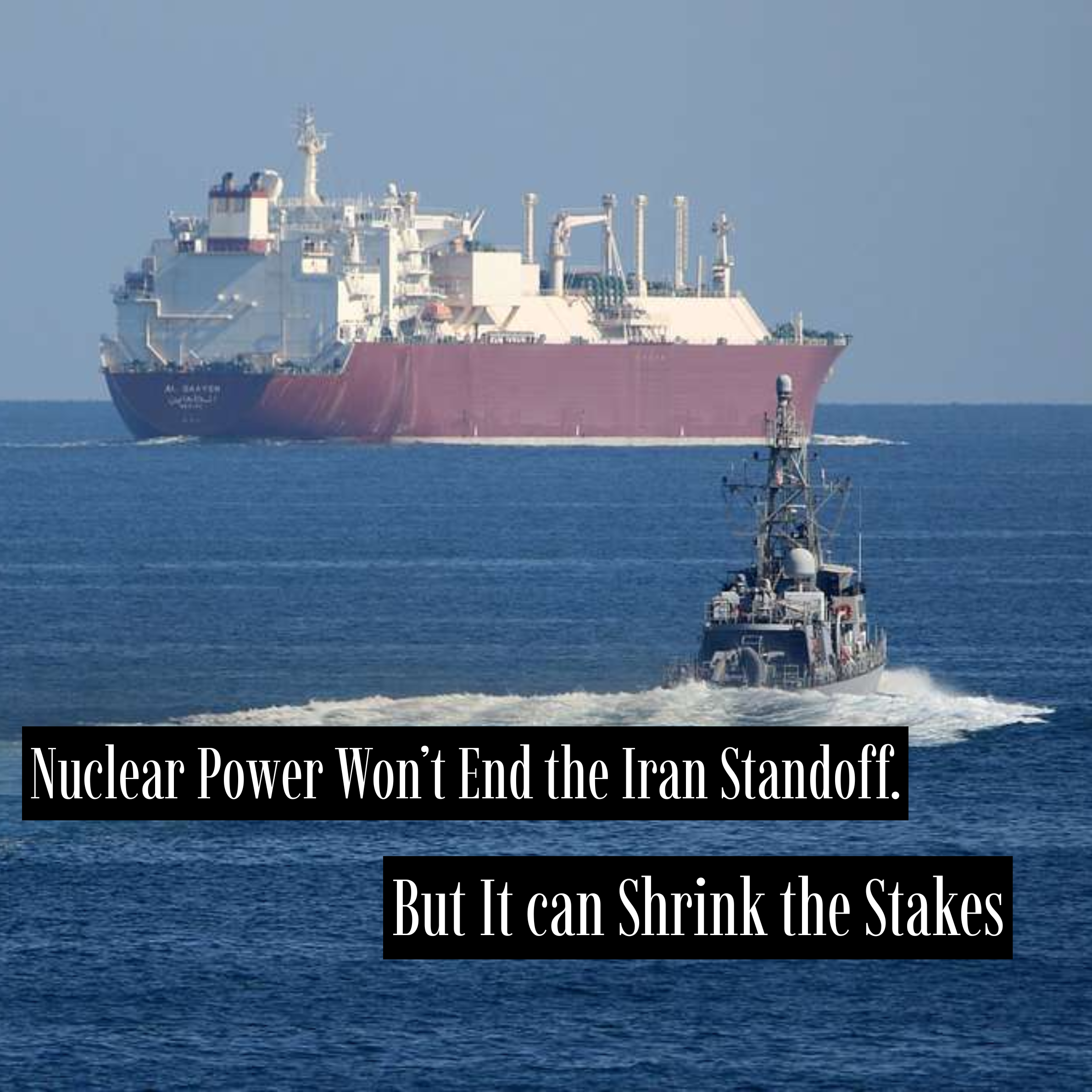
On February 28, 2026, American and Israeli planes bombed Iran, killing Supreme Leader Ali Khamenei and triggering a war that would drag on for months until its end in June via a ceasefire. But the widest-reaching effect of the war was neither a man nor any piece of land. It was the 21-mile-wide waterway that, within days, Iranian mines, missiles, and swarms of small attack boats rendered unusable. It was the Strait of Hormuz, a 104-mile stretch of water that carried nearly a fifth of the world's oil and liquefied natural gas from countries such as Saudi Arabia, the United Arab Emirates, Qatar, and Kuwait. According to the International Energy Agency, this was the biggest supply disruption in the history of the oil market. Brent crude shot past $100 per barrel for the first time in four years and peaked at $126. The governments of Thailand, Vietnam, and the Philippines rationed. Fertilizer prices rose, meaning that food became more expensive for tens of millions of people who had never heard of Bandar Abbas, the Iranian port city through which a third of the world's nitrogen-based fertilizer traveled. A regional war became a threat to the global economy in a week.
The global impact of this event has proven to be the most striking takeaway from 2026. It says little about who started the war. Instead, it speaks of a system that has left the whole planet vulnerable to threats. In a world run on hydrocarbons, whoever controls a strategic chokepoint is given extraordinary coercive power. Iran did not need to win the war to inflict worldwide pain. It only needed to threaten the trade going through the Strait.
There is something medieval about this concept: a toll castle on a river, but the river is carrying a fifth of the planet's energy, and the owner of the toll has leverage over the whole planet.
And what is particularly uncomfortable for Americans who think that drilling protects them from international threats is the fact that, despite the US being the world's top oil producer, it still suffered. The reason for that is simple: oil is a fungible, globally priced commodity that acts more like water in a connected bathtub, in which draining it at one point lowers the level in other places. When the price goes up in Singapore, it goes up in Houston. Drilling does not protect you from a supply chain problem; you only get protected when you need less oil.
The obvious answer to that would be that which climate activists have advocated for decades: build wind and solar plants, electrify everything, and let the sun solve what the Strait of Hormuz could not. But there is something that complicates this solution: the political viability of the policies that make it possible. The current American climate law operates under a four-year timer, with administrations passing and repealing laws and tax credits for projects that were never even begun. Transitioning to green energy takes three decades and cannot rely on legislation that survives four years. Moreover, investors understand that and take advantage of this political situation. What the current moment calls for is an energy source that can survive political swings as well as physical wear-and-tear, one that a red state and a blue state can both claim as their own.
This is where nuclear power comes into play, albeit from an unusual perspective. The country that suffered least from the Hormuz shock was France. The International Monetary Fund concluded that France and Spain have come out of it relatively unscathed, while economies dependent on gas imports, such as Italy and the UK, got hit the hardest. France gets about two-thirds of its electricity from nuclear reactors and uses almost no oil to keep its lights on. The fact that it happened was far from luck; it was the result of the French energy strategy adopted after the 1973 oil embargo. The Prime Minister of France at that time, Pierre Messmer, introduced an accelerated program for the construction of reactors with the purpose of compensating for the lack of natural resources and reliance on the global market. On the surface, the slogan of the era sounds arrogant: France had no oil, but it had ideas. But fifty years later, while its neighbors scrambled to find cargoes, France was quietly chugging along. Good infrastructure solutions tend to look this way: dull for decades, but then becoming the smartest thing anyone ever did.
The strategic logic of this idea is easily transferable. The power of the Strait of Hormuz to affect the planet's energy infrastructure, the very leverage that has made Iran so powerful, lies in the fact that it is the lever to influence the world's economies. If this dependence is weakened, so is the leverage. A consuming country that generates its electricity using reactors rather than imported gas is harder to influence. As a result, its government feels less pressure to spend blood and treasure keeping a distant waterway open, and producers find the chokepoint worth less as a weapon. Nobody blockades a strait the world has stopped caring about. This demand-side decarbonization does what sanctions and aircraft carriers cannot: it reduces the value of a chokepoint. It is why, just weeks after the closure of the strait, Japan (heavily reliant on foreign oil imports) and France reinforced their collaboration in the area of nuclear energy and supply-chain security. Two countries poor in resources and rich in industry learned the same lesson.
But none of that should be overstated, and here come three caveats. Firstly, the Hormuz crisis was as much about oil as electricity, and oil in advanced economies is a transportation fuel. Reactors provide electricity for cities but do not fuel trucks. Nuclear power reduces strategic exposure only when it works together with the electrification of transport and the slow and unglamorous process of replacing the internal combustion engine. France is protected on the power side, but it uses imported crude oil for its cars. Secondly, there is the dependency of nuclear power itself. France buys large amounts of uranium and enrichment services from Russia, which attracted protesters to the port of Dunkirk this spring, and trading an oil chokepoint for a uranium one is no achievement. Although, unlike gas, uranium stores well. It is easy to keep years of reactor fuel in a warehouse. Nobody keeps years of natural gas in one. Thirdly, reactors take a decade or more to be built, and France's own flagship project at Flamanville ran years late and billions over budget. Nuclear power is insurance that must be bought long before the fire, which is the main reason why governments do not buy enough of it. Crises provide the necessary willpower to build at exactly the moment when building can no longer help. Gas prices leave voters with a vivid memory, but leaders rarely get rewarded for the absence of a crisis twenty years later.
Finally, there is the paradox of this war, the one that should give any nuclear evangelist pause. The war was not about electricity at all; it was about enrichment. The civilian nuclear program of Iran, its centrifuges and stockpiles, was the cause of the conflict precisely because nuclear technology used to generate electricity can be pushed to the point of making bombs. The atom does not know what you want it to do. This dual-purpose nature makes nuclear diplomacy so complicated; the sixty-day framework signed by US President Trump and Iranian President Pezeshkian in June, with its unresolved issues regarding inspections and enrichment, is a testament to this problem. Prescribing "going nuclear" to everyone would, taken literally, proliferate the very capability that started the war.
The solution would be to separate the two halves of the atom. Strategic value lies in the demand-side nuclear power of the consuming countries, built according to strict nonproliferation measures: international guarantees for the supply of fuel, a strong IAEA safeguard regime, and agreements that bring reactors without enrichment capabilities. This is the approach the US already employs through its bilateral nuclear-cooperation agreements, providing the technology but withholding the most sensitive parts of the nuclear fuel cycle. Think of it as selling the car without the refinery. The goal of this strategy would be more reactors and fewer national enrichment programs; no centrifuge in every capital.
And what can nuclear power do about the US-Iranian crisis? Not much, unfortunately, since the problem is diplomatic and can only be solved by diplomacy and painful deal-by-deal negotiations. What a decades-long commitment to nuclear power can do is reduce the stakes of the chokepoint, blunt the oil weapon, and give diplomats some room for failure without the collapse of the planet's grocery bills. France understood back in 1973 what much of the world is relearning now in 2026: the cheapest defense against an oil weapon is to need less of it. The reactors that that lesson demands take years to build. As they say, the best time to plant a tree was before the strait closed. The second-best time is now.